

Juncture Wealth Strategies - Midterm Election Interference September 2026
SPECIAL RISK ANALYSIS
Potential Effects on U.S. Financial
Markets if a President Tries to Interfere with the November 2026 Congressional Elections
Legal limits, possible market reactions, lessons from history, risk scenarios, and investor considerations
Purpose and limits
This report examines a hypothetical risk. It does not claim that interference will occur, estimate the odds, or take a political position. Legal results would depend on the exact action and court decisions. The possible market moves described here are risk scenarios, not forecasts.
As of: September 9, 2026
Executive summary
Markets would react very differently to election interference depending on specific facts and circumstances. Political statements or failed lawsuits might cause only a brief period of volatility. A concerted effort to stop voting, ignore court orders, or prevent the new Congress from taking office would be far more damaging as it could weaken confidence in the U.S. government institutions that support the values of the stock and bond markets and the U.S. dollar and damage the safe haven status of Treasury securities.
Basic legal view
A President cannot cancel or postpone congressional elections acting alone. The Constitution gives states the main role in running elections and gives Congress the power to set or change election rules. Federal law sets one congressional Election Day. The 20th Amendment ends House terms and the affected Senate terms at noon on January 3. An executive order cannot extend those terms. [1]-[5]
Investment conclusions at a glance
Issue | Plain-English assessment |
Likelihood vs. impact | Investors may view cancellation of the elections as unlikely. Even so, the damage could be large as it would threaten stable government and the continued operation of Congress. |
Likely first reaction | Stocks fall, expected volatility rises, corporate borrowing costs increase, gold rises, and trading becomes less liquid. The dollar and Treasuries may initially rise as global investors seek cash and safety. |
Important second stage | Markets could rebound if courts, states, and Congress stop the effort quickly. If the conflict continues, the dollar could weaken and long-term Treasury yields could rise as investors demand extra return for political and long-term risk. |
Effect on the economy | Businesses may delay investment and hiring. Consumers may lose confidence. Borrowing costs may rise, federal budget decisions may be disrupted, and foreign investors may reduce purchases of U.S. assets. |
Most important sign to watch | Watch actions, not only statements: Are court orders followed? Can states run elections? Are results certified? Can the new Congress meet on January 3, 2027? |
1. Constitutional and operational rules
Who controls congressional elections?
Article I, Section 4 of the U.S. Constitution gives state legislatures the main responsibility for setting the times, places, and methods of House and Senate elections. It also gives Congress the power to change those rules. Congress has used this power to set one federal Election Day. In 2026, Election Day is Tuesday, November 3. States and thousands of local offices carry out the elections. [1]-[3]
The Constitution requires the President to faithfully enforce federal laws. It does not give the President the power to suspend an election law. Declaring a national emergency would not automatically change Election Day. Any attempt by Congress to change the timing would still face constitutional limits, practical problems in the states, voting-rights laws, and immediate court review. [4]
Why a delay is different than a cancellation
Possible action | What it could involve | How markets may view it |
Interference | Pressure on election officials or federal actions involving funding, mail, cybersecurity, law enforcement, or election information. | A policy and court risk that may remain manageable if judges and state election systems continue to function. |
Attempted short delay | An effort to change voting dates in some or all areas, probably followed by emergency requests for courts to block the action. | A constitutional conflict that raises questions about access to voting, certification of results, and public trust. |
Cancellation or refusal to accept results | An effort to stop voting entirely or reject winners whose elections were officially certified. | A major government crisis that threatens lawful transfers of power and predictable policymaking. |
Uneven election | Some states vote while voting in other states is blocked or delayed. | Questions about the legitimacy of the results and the risk that the House cannot seat enough members to operate. |
Why January 3 is a firm deadline
The 20th Amendment ends the terms of all House members and the affected Senators at noon on January 3. They do not stay in office simply because replacements have not been elected. House vacancies generally must be filled through elections. Senate vacancies may be filled temporarily by a governor only when state law allows it. If many elections failed, Congress might not have enough members to conduct business. It could struggle to choose leaders, pass spending bills, confirm officials, conduct oversight, or act on the debt limit. [5]-[6]
Important point
Courts would decide actual legal disputes. This report is not a legal opinion. The market analysis assumes that states and others would immediately challenge a presidential attempt to cancel an election. Market performance would depend less on the strength of the legal claim and more on whether courts and other institutions successfully stop the effort.
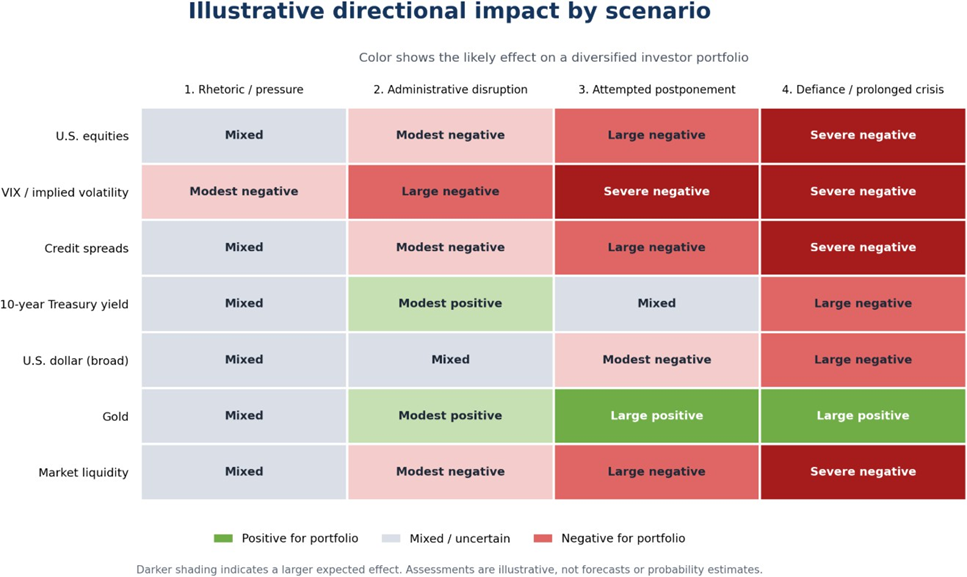
2. Scenarios and responses
Scenario | Example | Likely response | Possible market reaction |
1. Statements and legal pressure | Public threats, disputed rules, lawsuits, or claims that the election is invalid. | Courts hear the cases while election preparations continue. | Short bursts of volatility; different industries perform differently; markets rebound if the process remains intact. |
2. Disruption of election operations | Federal actions interfere with mail, data, funding, staff, or security support in selected areas. | States ask courts to stop the actions and create backup procedures. Government orders may conflict. | A broader move away from risk as markets adjust to greater election uncertainty. |
3. Attempted postponement | An executive order or emergency claim that seeks to delay voting nationwide or in key states. | States and Congress immediately go to court; the Supreme Court becomes involved; protests may occur. | A sharp stock decline and volatility spike; Treasuries and the dollar may rise at first, but their longer-term direction becomes uncertain. |
4. Defiance or cancellation |
The administration ignores final court orders, blocks the election, or refuses to accept certified results. | A major conflict develops among the President, Congress, courts, and states. Congress may be unable to operate normally. | A lasting increase in investment risk, money leaving U.S. assets, possible credit-rating downgrades, a weaker dollar, higher long-term yields, and reduced market liquidity. |
These scenarios do not estimate the odds of each outcome. Instead, they show how a crisis could become more serious. Markets could move from one stage to another very quickly. A dramatic announcement followed by a fast and effective legal response could cause a sharp selloff followed by a rebound, rather than lasting damage.
3. Impact on financial markets
Risk | How it could affect markets and the economy |
Loss of trust in institutions | Investors may demand higher returns when property rights, contracts, government policy, and lawful transfers of power become less predictable. |
Federal budget and government risk | A weakened Congress could delay spending bills, tax laws, emergency aid, appointments, or action on the debt limit. These delays could cause more economic damage than the election event itself. |
Consumer and business confidence | Households may delay spending. Companies may pause hiring, major investments, mergers, and new borrowing. Protests or political violence could occur. |
Foreign investors and the dollar | Foreign investors may reduce their holdings of dollar-based assets if they lose confidence in U.S. institutions. At first, however, global demand for dollars to pay debts and meet cash needs could strengthen the dollar. |
Liquidity and borrowed money | Dealers may make trading more expensive. Some institutional investors may sell or hedge their portfolios. Hedging can make price swings larger. Highly leveraged Treasury trades may face margin calls. |
Government response | The Federal Reserve, Treasury, SEC, exchanges, and bank regulators could help markets continue operating. They could not settle the larger question of whether the government is legitimate and functioning lawfully. |
Markets could react in two stages
Stage 1 - investors seek safety and cash: Stock prices fall, the VIX volatility index rises, corporate borrowing costs increase, gold rises, and short-term Treasury securities gain value. The dollar may also strengthen because it is widely used in global borrowing and trade.
Stage 2 - investors question U.S. institutions: If the conflict continues, investors may separate the dollar's role in global finance from concerns about U.S. government stability. Short-term Treasury bills could remain popular, while long-term Treasury yields rise because investors demand more return for added political and budget risk. The yield curve could steepen, the dollar could weaken, and gold could outperform.
4. Potential asset-class impacts
Investment | If the event is quickly contained | If the crisis continues | Important details |
Large U.S. stocks | Valuations fall temporarily; stable, high-quality companies perform better. | A broader decline in valuations; global and growth stocks are vulnerable to higher interest rates and currency swings. | After the initial shock, profits and Federal Reserve policy may matter more. |
Small U.S. stocks | Larger price swings; companies that depend on borrowing perform worse. | Greater pressure from tighter credit and weaker confidence in the U.S. economy. | Small stocks could rebound strongly if a resolution restores confidence. |
Treasury bills | Strong demand from investors seeking safety and cash. | Likely to remain popular, except for bills due near a possible debt-limit or payment disruption. | Federal cash-management plans and continued legal government authority would matter. |
Long-term Treasuries |
Prices may rise and yields may fall at first. | The direction is uncertain. Yields may rise because of greater political, inflation, budget, and foreign-demand risks. |
Do not assume long-term bonds will always protect the portfolio. |
Corporate bonds |
The extra yield over Treasuries rises modestly. | New borrowing may pause. Lower-quality bonds and leveraged loans could fall sharply, and credit downgrades may increase. |
Problems in banks and private-credit funds may appear later than public markets. |
U.S. dollar |
May rise as global investors seek dollars for funding and cash. | Could weaken against the Swiss franc, Japanese yen, euro, and gold if confidence in U.S. institutions falls. | Currency performance would also depend on economic conditions outside the United States. |
Gold |
Likely benefits from uncertainty. | Could rise strongly if the dollar or inflation-adjusted interest rates fall, or if investors seek alternatives to dollar reserves. | Gold can fall briefly when investors must sell assets to meet margin calls. |
Municipal bonds |
Performance differs by state, and trading may become less liquid. | Uncertainty about federal aid, taxes, and legal authority could raise yields; directly affected states may perform worse. |
Bonds backed by essential services may hold up better. |
Banks, brokers, and exchanges | More trading may raise revenue, but rapid price moves can create losses. | Funding, collateral, customer risk, and settlement problems become more important. | The government would likely support financial institutions and systems considered essential. |
5. Historical analogues and lessons
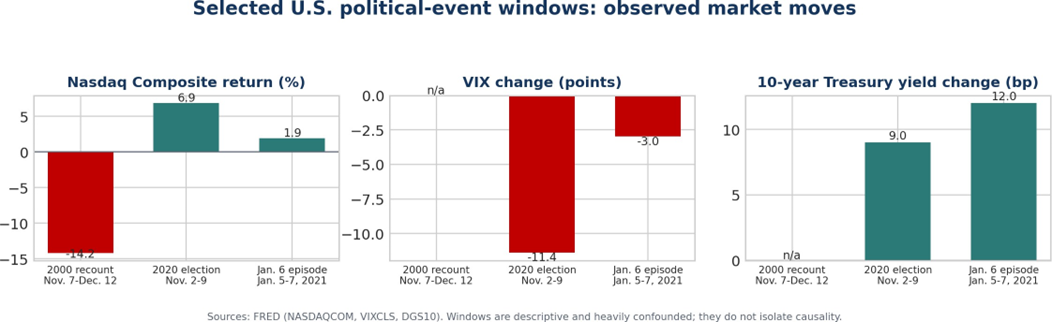
There is no close modern U.S. example of a president trying to cancel congressional elections. The historical events below are only partial comparisons. Their market effects are difficult to isolate because political crises often occur at the same time as recessions, wars, pandemics, changes in Federal Reserve policy, and shifts in corporate earnings.
2000 presidential recount: uncertainty can hurt markets, but other forces mattered
The Florida recount and court cases lasted from Election Day until the Supreme Court decided Bush v. Gore on December 12. The Nasdaq Composite fell significantly during that period. However, the dot-com decline, weaker profits, and an economic slowdown were already underway. News reports at the time linked some daily selling to election uncertainty, but they also pointed to weak business conditions. The key lesson is not the exact market decline. It is that uncertainty about who will govern can add more volatility when markets are already fragile. [7]-[9]
2020 election and January 6, 2021: clarity and containment mattered
Research using minute-by-minute market data found that uncertainty fell and risk assets generally improved as the 2020 presidential result became clearer. Treasury yields also moved as investors updated their expectations for control of government and future spending. Markets were relatively stable during the short period surrounding the January 6 attack on the Capitol. One reasonable explanation is that investors expected Congress to certify the result and the transfer of power to continue. Markets might react very differently if lawful court orders were ignored for weeks. [10]
1864, 1918, and 1942/1944: elections continued during national emergencies
The United States held national elections during the Civil War, the 1918 flu pandemic and World War I, and World War II. These emergencies made voting and election administration harder, but elections still occurred on schedule. The examples support the view that the United States works around emergencies rather than using them to eliminate elections. They show how institutions behaved, but they are not direct studies of market performance. [11]-[12]
September 11 market closure: financial systems can be stabilized
After the September 11, 2001 attacks, bond and futures markets reopened on September 13. Stock and options markets reopened on September 17 after extensive system testing. The Federal Reserve provided large amounts of liquidity, and the SEC temporarily relaxed some rules to help markets function. This example shows that coordinated and lawful government action can limit operational damage. It does not show that regulators can solve a crisis over the legitimacy of the government itself. [13]-[14]
Watergate: avoid claiming an exact market effect
The 1973-74 constitutional crisis happened at the same time as the oil embargo, a recession, high inflation, and a severe bear market. Watergate shows that political stress can make a weak economy and market worse. However, it is not possible to calculate a reliable market decline caused by Watergate alone. In 2026, stock valuations, inflation, Federal Reserve policy, and credit conditions would strongly affect the size of any decline.
6. What would determine the size and duration of the shock?
Events that could calm markets | Events that could make the crisis worse |
Courts act quickly and all sides follow their orders | The administration openly ignores final court orders |
Members of both parties defend the election schedule | Congress cannot act or different groups claim authority |
States continue voting and certification using backup systems | Federal actions cause major differences in voting access among states |
Military and law-enforcement agencies remain politically neutral and follow the law | Force is used or threatened against election operations |
The Fed, Treasury, SEC, exchanges, and clearinghouses work together to support liquidity | Treasury trading breaks down, margin calls cause forced selling, or federal payments become uncertain |
The conflict ends within a clear time and the results are accepted | There is no clear endpoint, states submit competing results, or the new Congress cannot organize |
7. Timeline of market-sensitive decision points
Period | What investors may watch | Main market question |
Before Nov. 3, 2026 | Election rules, lawsuits, mail and ballot operations, security plans, and federal-state disputes. | Can the election still operate fairly and consistently across the country? |
Election Day and vote counting | Access to voting, disruptions, result reporting, emergency court orders, and conditions in stock and funding markets. | Can voting and counting continue, and is any disruption local or nationwide? |
Certification period | Official state counts, recounts, court orders, and competing claims. | Will states produce lawful certificates, and will officials respect them? |
January 3 deadline | Current terms end and the 120th Congress is scheduled to begin. | Can the House and Senate confirm their members, reach a quorum, choose leaders, and pass laws? |
After Congress organizes | Spending bills, the debt limit, appointments, investigations, and tax and budget policy. | Has the added investment risk faded, or has it become long-lasting? |
Conclusion
A President acting alone would face major constitutional, legal, state-level, and court barriers in trying to postpone or cancel the November 2026 congressional elections. Because the legal case would be weak, lasting market damage could be limited if institutions respond quickly and court orders are followed. The greatest risk is not simply that an election does not occur. It is a long conflict that creates uncertainty about whether Congress can meet and legally act.
For investors, the key difference is between short-term market volatility and a lasting increase in the risk that investors attach to U.S. institutions. Short-term volatility can reverse quickly. A lasting loss of trust could reduce the value of many
U.S. investments by raising borrowing costs, reducing foreign demand, and creating problems for federal spending and financial-market operations. Investors should therefore watch whether laws and court orders are followed and whether the government continues to function, rather than reacting to political statements alone. Additionally, investors can review their asset allocation with their advisor to determine if they are comfortable with the level of risk in their portfolios.
Sources and notes
- U.S. Constitution, Art. I, §4, cl. 1 (Elections Clause), Constitution Annotated. https://constitution.congress.gov/browse/essay/artI-S4-C1-2/ALDE_00013577/
- 2 U.S.C. §7, uniform date for election of Representatives and Delegates. https://www.govinfo.gov/content/pkg/USCODE-2020-title2/html/USCODE-2020-title2-chap1-sec7.htm
- U.S. Election Assistance Commission, 2026 election-administration materials. https://www.eac.gov/
- Congressional Research Service, Postponing Federal Elections and the COVID-19 Pandemic: Legal Considerations, LSB10443.
https://crsreports.congress.gov/product/pdf/LSB/LSB10443
- U.S. Constitution, Amendment XX, §1; Constitution Annotated discussion of congressional terms.
https://constitution.congress.gov/browse/essay/amdt20-S1-1/ALDE_00001006/
- U.S. Constitution, Art. I, §2, cl. 4 (House vacancies) and Amendment XVII (Senate vacancies). https://constitution.congress.gov/constitution/
- Bush v. Gore, 531 U.S. 98 (2000). https://supreme.justia.com/cases/federal/us/531/98/
- Federal Reserve Board, November 2000 Bluebook (contemporaneous economic/market background).
https://www.federalreserve.gov/monetarypolicy/files/fomc20001115bluebook20001109.pdf
- FRED, Nasdaq Composite (NASDAQCOM); report calculations. https://fred.stlouisfed.org/series/NASDAQCOM
- DeHaven, Firestone & Webster, “Minute-by-Minute: Financial Markets’ Reaction to the 2020 U.S. Election” (2024 working paper).
https://arxiv.org/abs/2407.03527
- National Archives, 1864 Electoral College Results. https://www.archives.gov/electoral-college/1864
- U.S. Senate Historical Office, “November 5 Election in Doubt” (1918 influenza election). https://www.senate.gov/about/origins-foundations/electing-appointing-senators/world-war-i-mid-term.htm
- SEC Chair Harvey Pitt, testimony on financial markets after September 11 (Sept. 26, 2001).
https://www.sec.gov/news/testimony/092601tshlp.htm
- Federal Reserve, testimony on protecting financial infrastructure and post-9/11 continuity.
https://www.federalreserve.gov/boarddocs/testimony/2004/20040908/
- FRED, VIX (VIXCLS) and 10-Year Treasury Constant Maturity Rate (DGS10); report calculations. https://fred.stlouisfed.org/series/VIXCLS
Method and limits
The market scenarios in this report show possible directions, not precise forecasts. Historical market data come from FRED and use daily closing values. The analysis does not separate political events from economic news, earnings, policy changes, or global events occurring at the same time. This report does not assign probabilities, recommend specific trades, provide legal advice, or guarantee that any hedge will work. Sources were accessed or verified as of September 2, 2026.
This commentary is provided to you for informational purposes only and should not be considered investment advice, a recommendation to adopt any investment strategy, or a solicitation for services. Any specific firm or security presented should not be construed as an endorsement or recommendation by Juncture Wealth Strategies, LLC. No advice may be rendered by Juncture Wealth Strategies, LLC unless a client service agreement is in place. Please consult with your financial advisor before making any investment. Investing involves risk, including the possible loss of principal. Information provided by Bloomberg, YCharts, Alpine Micro, government data resources and other 3rd party economic data providers is believed to be reliable but the accuracy and completeness of the information cannot be guaranteed. For information pertaining to the registration status, fees, services or other information of JWS, please contact JWS or refer to the Investment Adviser Public Disclosure website (www.advisorinfo.sec/gov) for our disclosure statement as set forth on Form ADV. For financial planning advice specific to your circumstances, talk to a qualified professional at JWS. Tax laws are subject to change, readers should consult with their qualified tax advisor when making decisions regarding these matters. Juncture Wealth Strategies is not a law firm and does not provide legal advice to clients.